Learn Salsa in 5 Minutes
You do not need a partner, a studio or perfect rhythm to start. Put on a medium-tempo salsa song, clear a little floor space and work through these three short lessons in order. Each one builds on the last.
We teach the counts the LA On1 way because it is the most common starting point in social classes. If you later fall for New York On2 or Cuban casino, everything you learn here about weight changes, posture and connection still applies.
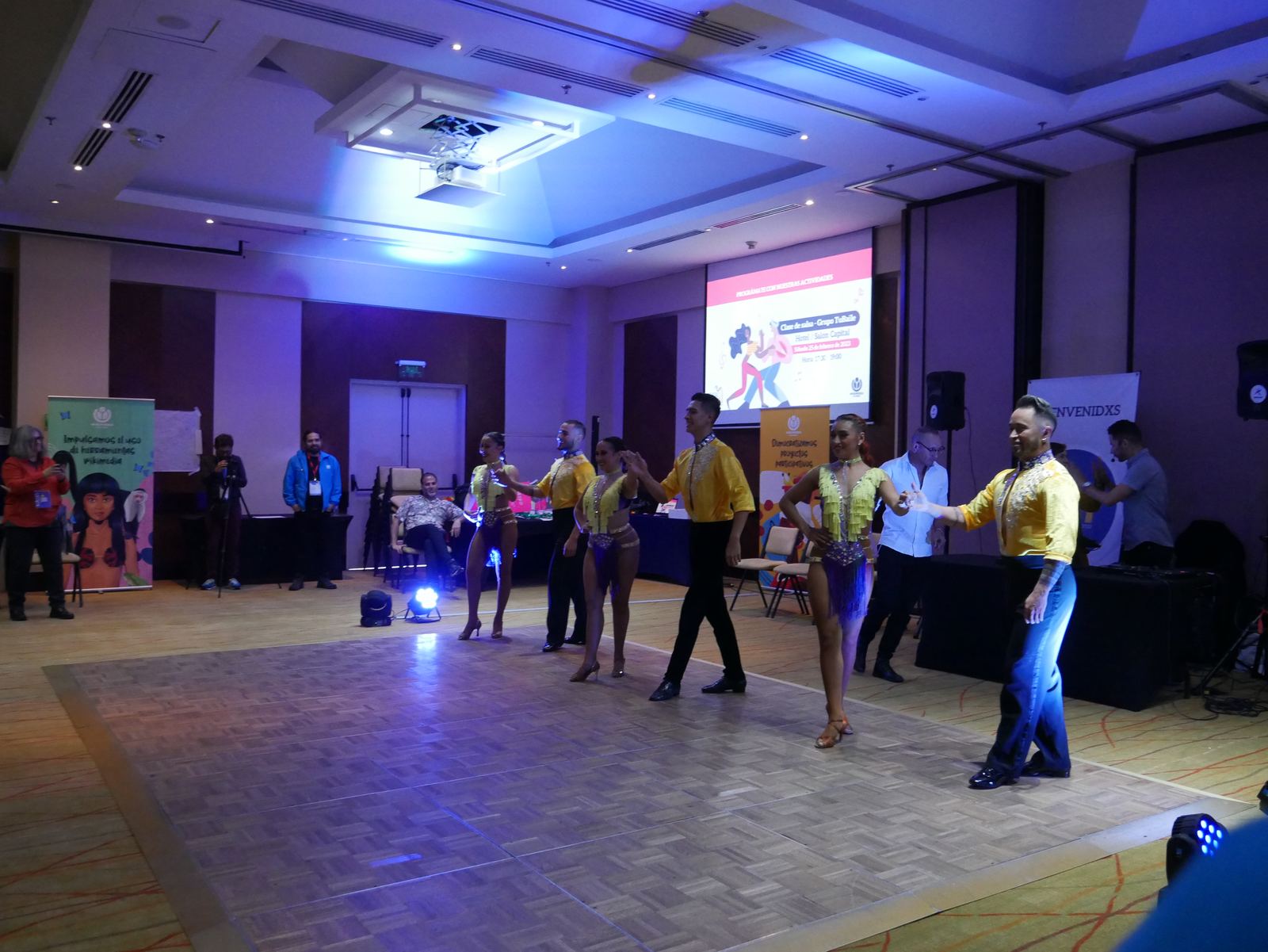
A salsa class in progress: Luis Alvaz, CC BY-SA 4.0
Three lessons, about five minutes each
Count out loud: one, two, three, (pause), five, six, seven, (pause). Salsa uses three steps for every four beats, so beats 4 and 8 are your breathing room.
Lesson 1: The basic step (On1)
The basic is a forward-and-back rock that fills one eight-count phrase. Leaders start with the left foot forward, followers with the right foot back. Practice solo first, then mirror a partner.
- Count 1 Leader steps forward with the left foot. Follower steps back with the right foot. This is the break step, the moment you change direction.
- Count 2 Shift your weight onto the other foot without moving it: leader onto the right, follower onto the left.
- Count 3 Bring the stepping foot back home so your feet are together again, and keep your weight on it.
- Count 4 Pause. Do not step. Let the music carry you and keep your knees soft.
- Count 5 Leader steps back with the right foot. Follower steps forward with the left foot. This is the second break.
- Count 6 Shift your weight onto the front or back foot in place: leader onto the left, follower onto the right.
- Count 7 Close the feet together again, weight on the foot that just moved.
- Count 8 Pause, breathe, and get ready to start again on 1.
Tip: Keep the steps small, about the length of your own foot. Big steps make you late on the next count, and small steps let you keep up when the song gets fast.
Lesson 2: Your first turns and spotting
Once the basic feels automatic, add a turn. We start with the follower's right turn (clockwise) and then the inside turn, which spins toward the leader. Spotting keeps you from getting dizzy.
- Learn to spot Stand still and pick a point at eye level, such as a light switch or your partner's face. As you turn, keep your eyes on it as long as you can, then whip your head around quickly and find the same point again before your body finishes the turn.
- Right turn, counts 1 to 3 Dance the first half of the basic as normal. The leader lifts the joined hands (leader's left, follower's right) slightly above the follower's head as a signal.
- Right turn, counts 5 to 7 The follower steps forward on 5 and pivots to the right on the balls of the feet, completes the turn on 6 and closes on 7 facing the leader. The leader keeps a light circling motion in the hand above the follower's head and dances a small basic in place.
- Inside turn The inside turn goes the other way, counterclockwise for the follower, so the follower spins in toward the leader. It is usually led on 5, 6, 7, often as the follower walks past during a cross-body lead. The same spotting rule applies.
- Recover Pause on 8, check your balance and go straight back into the basic. A clean finish matters more than a fast spin.
Tip: Leaders: guide the turn with a light halo over the follower's head, never by pulling the arm down. Followers: keep your raised arm firm but not stiff, so you can feel the signal.
Lesson 3: Connection, frame and the cross-body lead
Partner work depends on frame: a gentle, springy tension in your arms and back that lets two people feel each other's movement. The cross-body lead, the signature move of LA and New York style, is the best way to practice it.
- Build the frame Stand tall, shoulders down, elbows slightly in front of your ribs. In closed hold the leader's right hand rests on the follower's shoulder blade and the follower's left hand rests on the leader's shoulder. Free hands meet at about chest height with light pressure.
- Counts 1 and 2 Dance the first half of the basic: leader forward with the left and rock back onto the right, follower back with the right and rock forward onto the left.
- Count 3 The leader steps the left foot back and turns about 90 degrees to the left, opening a lane. The follower steps forward with the right foot and walks into that lane. Count 4 is a pause.
- Counts 5 and 6 The leader steps back with the right foot to keep the lane open, then turns back to face the slot on 6. The follower steps forward on 5 and makes a half turn to the left on 6, ending up facing where she came from.
- Counts 7 and 8 Both close the feet and pause. You now face each other again, with your ends of the slot swapped.
Tip: Lead with your body, not your arms. When the leader turns, the frame turns too, and the follower feels a clear invitation instead of a tug.
Where to go next
Want more detail? Our full Basic Step and Cross-Body Lead guides break each count down further, and the Clave Rhythm page explains the pulse the band is playing around you.
When you are ready to try a real dance floor, see our Where to Dance guide and pick music from our practice playlists.
Beginner questions
Do I need a partner to learn salsa?
No. Most group classes rotate partners, and you can practice the basic, turns and shines alone at home. A partner helps once you start working on connection and leads.
Should I learn On1 or On2 first?
Most beginner classes teach On1 because the break step lands on the first beat, which is easier to hear. On2 is not harder in principle, just different. Start with whatever your local scene dances most.
How fast is salsa music?
Salsa is usually somewhere between about 150 and 250 beats per minute, and most social dancing happens roughly between 160 and 220. Start with slower songs and work up.
What should I wear to my first class?
Comfortable clothes you can move and sweat in, and shoes that let you pivot. Avoid rubber soles that grip the floor hard, since they make turns tough on the knees. Our gear page has more detail.
Why do people count 1, 2, 3, 5, 6, 7?
Salsa uses three steps over four beats. Dancers skip saying 4 and 8 because those beats are the pauses, which keeps the count tidy and the steps on time.
- Wikipedia: Salsa (dance), tempo and basic rhythm
- Salsa Vida: LA Style Salsa (On 1)
- Salsa Vida: New York Style Salsa (On 2)
- The Dance Dojo: Salsa timing On1, On2 and On3
Facts on this page were checked against these sources (updated Oct 1, 2026). Spot an error? Email hello@fireempireshop.com.